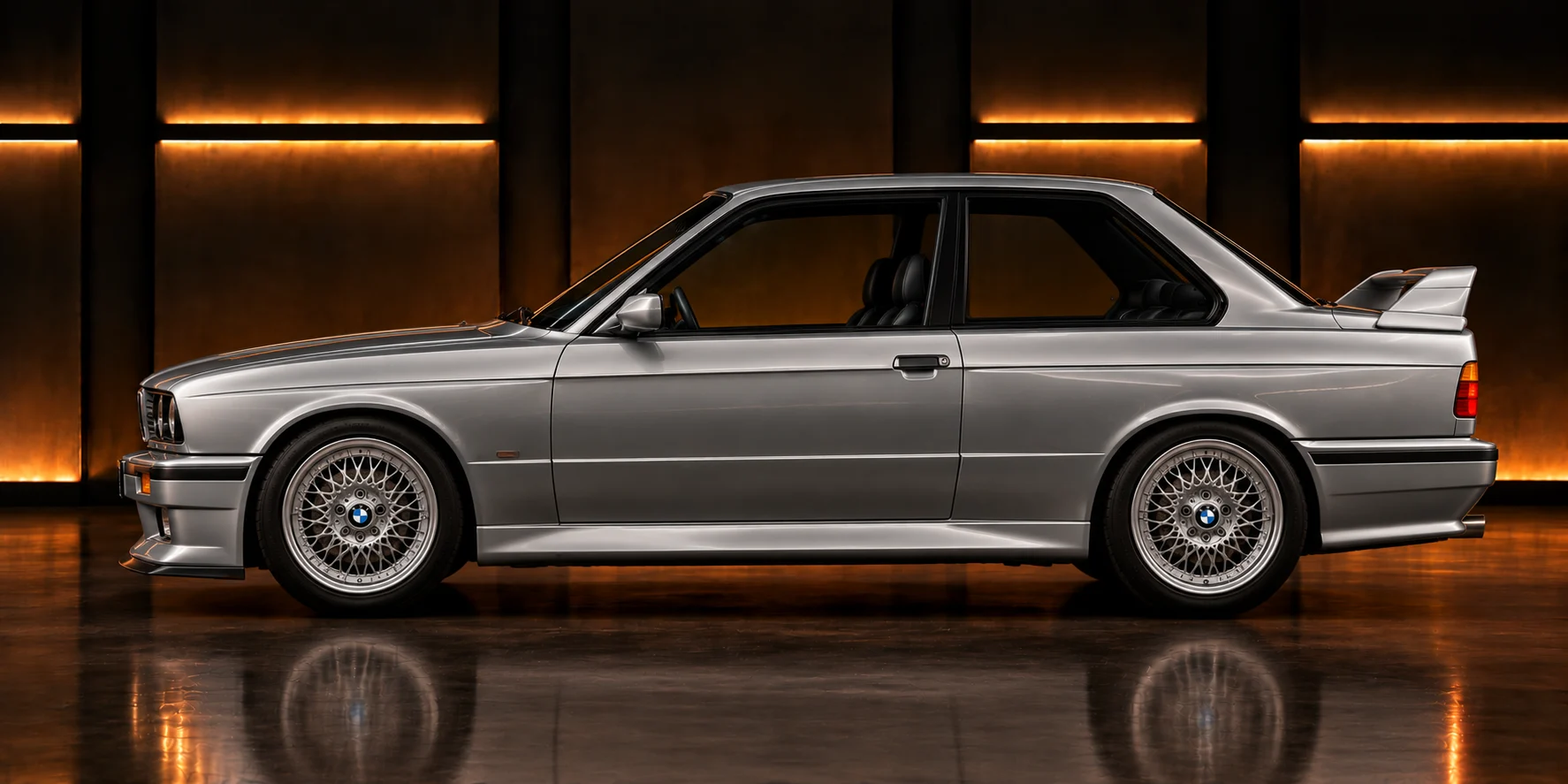
M3 E30
- Engine
- 2.3 L inline-four (S14)
- Power
- 192 hp (US)
- Weight
- ≈2,740 lb
- Layout
- Front-engine
- Drive
- RWD
These are starting points gathered from the sources listed at the bottom, not a guarantee. Cars, tires and parts vary: have a reputable alignment shop set your car, check factory specs for road use, and change one thing at a time.
01On track
- +Low weight and a small footprint make it nimble and easy on tires and brakes
- +Rev-happy S14 rewards keeping the car in its power band
- +Communicative steering and a chassis that talks to the driver
- +Simple, analog car with a long racing history and a dedicated parts network
- −Modest power by modern standards; a mistake mid-corner costs a lot of lap time
- −Very little front camber adjustment from the factory
- −Age: rubber bushings, cooling parts and chain tensioner are all decades old on many cars
- −High values make crash damage and wear expensive; many owners choose not to risk one on track
02Alignment
Where to start the alignment.
| Front | Rear | |
|---|---|---|
| Camber | -3.0° to -4.5° | -1.0° to -3.0° (owners disagree) |
| Toe | 0 to 2 mm out (total) | 1 to 2 mm in per side |
| Caster | As much as possible, or about factory | — |
Owner consensus from an E30 forum, not a shop spec, and it covers all E30s rather than the M3 alone. About -3.5° front is a common figure on R-compound tires; one owner found that much camber wore the outer edges quickly. Owners split on rear camber: some run little to keep rear traction, others up to -3°. Rear toe-in adds straight-line stability. Use adjustable plates and a pyrometer to fine-tune.
Sources [5]
03Tires & brakes
Tires and brakes
- 200TW endurance
- Bridgestone Potenza RE-71RS
- Yokohama Advan A052
- Falken Azenis RT660+
- Nankang Sportnex CR-S
- BFGoodrich g-Force Rival S 1.5
215/40-17 on 17x8" ET20 (direct fit); 215/35-18 on 18x8.5" ET35 with 15 mm spacers; 235/40-17 on 17x8.5" for highly modified cars (rolled rear fenders may be needed)Picks are from the 2025 Tire Rack 200TW track test, which used a modern car. Check that your size exists in each model: the small E30 M3 sizes have fewer choices. Apex says wider staggered fitments can rub depending on tire brand.
BimmerWorld lists Performance Friction 08 (endurance and long track days) and PFC 11 (sprints) for the E30 M3 rear. The M3 front caliper is not the same as the 325i, so confirm front fitment with the vendor and run matched compounds front and rear.
A normal-viscosity, high-boiling fluid such as Castrol SRF (518°F wet) or Motul RBF 600 (about 400°F wet).
Glycol fluids need flushing at least every one to two years, and more often with track use. [7,8]
04Known issues on track
Fix these before they find you.
Timing chain tensioner
Euro Premium Parts rates the S14 chain tensioner and guides as the most serious engine item. A rattle at cold start is the classic warning sign, and ignoring it can let the chain slip and wreck the engine. They suggest checking from about 50,000 miles. Do it before the first event if the history is unknown. [2,3]
Cooling system age
Hoses, the plastic expansion tank, thermostat and water pump are well past their service life on original cars. Overheating, coolant loss and high temperatures under load are the symptoms. The guides recommend a complete refresh, with an OEM-spec water pump, and a coolant flush every two years. [2,3]
Oil consumption and oil choice
Worn valve guides can raise oil use; up to about one quart per 1,000 miles is described as acceptable. Check the level between sessions. The guides suggest a 10W-40 or 15W-50 mineral or semi-synthetic oil on older engines and short change intervals, because tensioner health depends on good oil pressure. [2,3]
Front strut tower corrosion
The flared bodywork traps moisture and the front strut towers can rust badly enough to weaken the structure. Rated a critical check on any E30 M3. Inspect them before adding camber plates, which load the towers. [2]
Rear trailing arm bushings
The bushings harden and crack with age, which makes the rear end vague and clunky. Most cars over 30 years old need them. Fresh bushings are a cheap way to make the alignment hold. [2]
05Modification roadmap
In the order that pays off.
- 0Safety & reliability first
Safety and reliability first
- Chain tensioner and guidesA tired tensioner is the most expensive way for an S14 to fail.
- Complete cooling refreshEvery rubber and plastic cooling part is decades old on an original car.
- Strut tower and rust inspectionRotten towers are a structural problem, and plates add load there.
- Track pads and fresh high-boiling fluidOld fluid boils quickly, and street pads fade on track.
- Seats and harnesses only with proper roll protectionNever fit harnesses without a roll bar or cage.
- 1Tires & alignment
Bushings, tires and alignment
- Rear trailing arm bushings and other worn rubberAged bushings let the alignment move under load.
- 200TW tires on 17x8" wheelsA modern compound is the biggest single gain for the money.
- Camber plates and a track alignmentThe stock car has almost no front camber adjustment.
- 2Suspension & brakes
Suspension
- Quality dampers and springsBetter body control; keep it compliant, as the E30 likes to move a little.
- Firmer front bar, softer rearOwner advice for balance and rear traction on a car with a limited-slip diff.
- 3Power & aero
Power last
- Engine workS14 power is expensive. Spend on driver training and seat time first.
06Performance planner
What each upgrade is worth on this car.
Pick upgrades and see the estimated lap-time change on a reference circuit, how much margin your brakes and engine have late in a session, and which changes buy durability rather than speed.
Reference circuit (fictional, 3.5 km). Late lap includes brake fade and heat derating once the system runs out of margin.
- R-compound tires−4.58%load ↑
- 200TW endurance tires−2.29%load ↑
- Track alignment−0.73%
- Street/track pads−0.67%durability ↑
- Race pads−0.67%durability ↑
- High-temp fluid−0.67%durability ↑
- Brake cooling ducts−0.67%durability ↑
- Big brake kit−0.62%durability ↑
- Coilovers + sway bars−0.61%
- Oil cooler + radiator−0.56%durability ↑
- Splitter + wing−0.46%
- Lighter wheels + seat−0.37%
- Oil system (baffles / accumulator)±0
- Limited-slip differential±0
- Intake, exhaust, tune±0load ↑
Estimates from a simplified point-mass lap simulation of M3 E30 (2,741 lb, 192 hp) on a fictional circuit, with generic effects for each upgrade category. Good for comparing options on the same car, not for predicting your lap time. Real results depend on the driver, the exact parts, the track and the conditions. Durability starts lower on this car because of its known issues: heat.
Sources
Last reviewed 2026-10-18. Summaries are TRACK’s own wording; follow the links for the original detail. Product and brand names belong to their owners.
- [1]1988 BMW M3 E30 specificationsConceptcarz · accessed 2026-10
- [2]BMW M3 E30 Reliability GuideEuro Premium Parts · accessed 2026-10
- [3]BMW S14 Engine Guide: Reliability, Common Problems & Tuning PotentialEuro Premium Parts · accessed 2026-10
- [4]BMW E30 M3 Wheel & Tire Fitment GuideApex Race Parts · accessed 2026-10
- [5]Track day set up (owner discussion)E30 Zone forum · accessed 2026-10
- [6]Camber / Caster Kits for BMW E30 M3Turner Motorsport · accessed 2026-10
- [7]Race & Track Brake PadsBimmerWorld · accessed 2026-10
- [8]Brake FluidBimmerWorld · accessed 2026-10
- [9]2025 Tire Rack Extreme Performance Track Tyre Test (summary of Tire Rack data)Tyre Reviews · accessed 2026-10