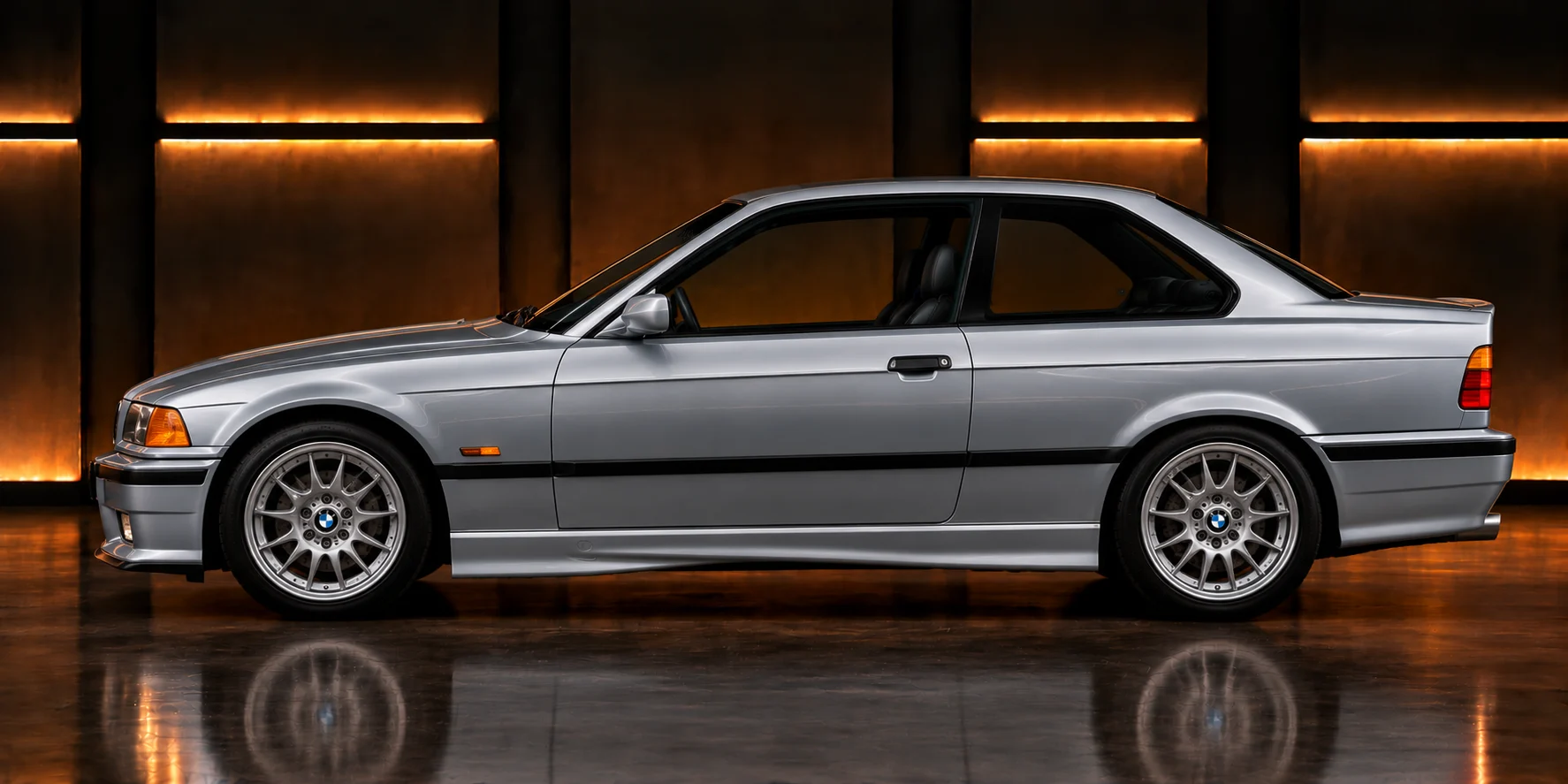
325i / 328i E36
- Engine
- 2.5 L (M50) or 2.8 L (M52) inline-six
- Power
- ≈190 hp
- Weight
- ≈2,980 lb
- Layout
- Front-engine
- Drive
- RWD
These are starting points gathered from the sources listed at the bottom, not a guarantee. Cars, tires and parts vary: have a reputable alignment shop set your car, check factory specs for road use, and change one thing at a time.
01On track
- +Balanced, forgiving rear-drive chassis that is easy to learn on
- +Cheap to buy and run, with huge parts availability
- +Shares suspension and brake upgrades with the E36 M3
- +Smooth, durable inline-six when the cooling system is healthy
- −Modest power; momentum driving only
- −Plastic cooling parts fail with age and heat
- −Rear subframe mounting points can crack on hard-driven cars
- −Worn bushings and mounts on most cars make the rear vague
02Alignment
Where to start the alignment.
| Front | Rear | |
|---|---|---|
| Camber | -3.0° to -3.8° | -2.0° to -2.5° |
| Toe | 0 to 1/16" out | 0 to 1/16" in per side |
| Caster | As much as the plates allow | — |
Owner consensus and one documented build: a NASA ST4 325is on 255/40-17 Toyo Proxes RR ran -3.8° front, -2.5° rear, 1/16" front toe-out and zero rear toe. E36 M3 owners report -3.2° to -3.5° front and -2.0° rear with a little rear toe-in. Rear camber beyond stock needs adjustable rear arms, which BimmerWorld makes for the non-M E36.
03Tires & brakes
Tires and brakes
- 200TW endurance
- Bridgestone Potenza RE-71RS
- Yokohama Advan A052
- Falken Azenis RT660+
- Nankang Sportnex CR-S
- BFGoodrich g-Force Rival S 1.5
Square 17" setups; 255/40-17 square on a documented race buildPicks are from the 2025 Tire Rack 200TW track test. A square 17" setup is good value and lets you rotate tires.
BimmerWorld lists Performance Friction 08 (endurance, long track days) and PFC 11 (sprints) for the non-M E36 front. Confirm rear fitment and run matched compounds.
A normal-viscosity, high-boiling fluid such as Castrol SRF (518°F wet) or Motul RBF 600 (about 400°F wet).
Glycol fluids need flushing at least every one to two years, more often with track use. [9,10]
04Known issues on track
Fix these before they find you.
Cooling system
The plastic expansion tank, radiator end tanks, thermostat housing and the plastic water pump impeller are the weak points, and six-cylinder cars have more trouble than fours. A broken impeller can block coolant passages and cause overheating that damages the head gasket. FCP Euro suggests replacing every cooling part by about 80,000 miles, with a metal-impeller pump and an aluminum radiator. [3,4]
Rear subframe mounts
The body mounting points for the rear subframe can crack or tear, especially on cars that are driven hard or tracked. Inspect before buying and add reinforcement plates before cracks start. [4]
Bushings and mounts
Rear trailing arm bushings, rear shock mounts and engine and gearbox mounts are typically worn out by about 80,000 miles. Symptoms are clunks, uneven rear tire wear and a vague rear end. [4,5]
VANOS and crankcase ventilation (M52)
VANOS seals degrade after about 100,000 miles, causing rough idle and lost power. A failed CCV diaphragm causes oil use and smoke; replace it on high-mileage engines. [4]
05Modification roadmap
In the order that pays off.
- 0Safety & reliability first
Safety and reliability first
- Complete cooling refreshWater pump with a metal impeller, radiator, expansion tank, thermostat and hoses.
- Rear subframe inspection and reinforcementTrack loads find weak mounting points.
- Track pads and fresh high-boiling fluidStreet pads and old fluid fade quickly.
- Seats and harnesses only with proper roll protectionNever fit harnesses without a roll bar or cage.
- 1Tires & alignment
Bushings, tires and alignment
- Rear trailing arm bushings, shock mounts and engine mountsMost cars have tired rubber that lets the alignment move.
- Square 17" wheels with 200TW tiresThe biggest single gain for the money.
- Camber plates and a track alignmentStock front camber is not enough for track tires.
- 2Suspension & brakes
Suspension
- Coilovers or quality dampers and springsBetter body control and ride height adjustment.
- Adjustable rear camber armsSet rear camber once the car is lowered.
- 3Power & aero
Power last
- Engine workSpend on reliability, tires and seat time first.
06Performance planner
What each upgrade is worth on this car.
Pick upgrades and see the estimated lap-time change on a reference circuit, how much margin your brakes and engine have late in a session, and which changes buy durability rather than speed.
Reference circuit (fictional, 3.5 km). Late lap includes brake fade and heat derating once the system runs out of margin.
- R-compound tires−4.70%load ↑
- 200TW endurance tires−2.23%load ↑
- Track alignment−0.71%
- Street/track pads−0.64%durability ↑
- Race pads−0.64%durability ↑
- High-temp fluid−0.64%durability ↑
- Brake cooling ducts−0.64%durability ↑
- Big brake kit−0.60%durability ↑
- Coilovers + sway bars−0.60%
- Oil cooler + radiator−0.59%durability ↑
- Splitter + wing−0.37%
- Lighter wheels + seat−0.36%
- Oil system (baffles / accumulator)±0
- Limited-slip differential±0
- Intake, exhaust, tune±0load ↑
Estimates from a simplified point-mass lap simulation of 325i / 328i E36 (2,981 lb, 190 hp) on a fictional circuit, with generic effects for each upgrade category. Good for comparing options on the same car, not for predicting your lap time. Real results depend on the driver, the exact parts, the track and the conditions. Durability starts lower on this car because of its known issues: heat.
Sources
Last reviewed 2026-10-18. Summaries are TRACK’s own wording; follow the links for the original detail. Product and brand names belong to their owners.
- [1]BMW 3 Series (E36)Wikipedia · accessed 2026-10
- [2]1997 BMW 3 Series Specs, Features & OptionsKelley Blue Book · accessed 2026-10
- [3]5 Of Our Favorite Cars With Notoriously Unreliable Cooling SystemsFCP Euro · accessed 2026-10
- [4]BMW 3 Series E36 Reliability GuideEuro Premium Parts · accessed 2026-10
- [5]BMW E36 M3 Common Issues & RepairsFCP Euro · accessed 2026-10
- [6]Recommend alignment settings for E36 M3? (owner discussion)Grassroots Motorsports forum · accessed 2026-10
- [7]BMW E36 3 Series with 17" VS-5RS Wheels (NASA ST4 build)Apex Race Parts · accessed 2026-10
- [8]BimmerWorld Race Adjustable Rear Camber Arm Set - E36, E46, Z4BimmerWorld · accessed 2026-10
- [9]Race & Track Brake PadsBimmerWorld · accessed 2026-10
- [10]Brake FluidBimmerWorld · accessed 2026-10
- [11]2025 Tire Rack Extreme Performance Track Tyre Test (summary of Tire Rack data)Tyre Reviews · accessed 2026-10